
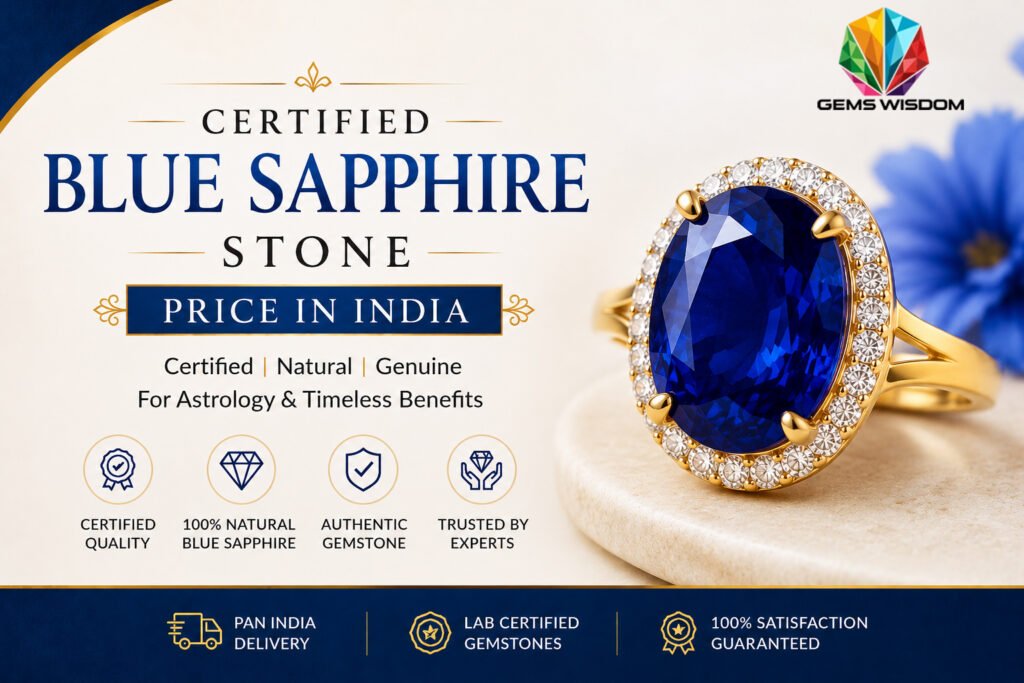
The Blue Sapphire Stone Price in India typically ranges from ₹2,000 to ₹5,00,000+ per carat, depending on origin, colour, clarity, carat weight, treatment, and certification. Natural, untreated stones from premium origins like Kashmir and Ceylon sit at the higher end, while treated or lower-grade stones from Thailand and Madagascar are more affordable entry points.
Blue Sapphire, also called Neelam, is one of the most valuable gemstones in both fine jewellery and Vedic astrology — making the Blue Sapphire Gemstone Price in India a frequent question among both buyers. Linked to the planet Saturn (Shani), it’s prized for its deep blue colour and durability — it’s one of the hardest gemstones after diamond, making it a practical choice for daily-wear rings and pendants, not just occasional jewellery.
(Buying it specifically for astrological use? See our Original Neelam Stone Price in India guide for rashi suitability, wearing rituals, and gemstone combinations.)
Blue Sapphire Stone Price in India (Per Carat, By Origin)
| Origin | Typical Price (per carat) | Best For |
|---|---|---|
| Ceylon / Sri Lanka | ₹2,000 – ₹32,000+ | Astrology & daily wear (most recommended) |
| Burma / Myanmar | ₹5,000 – ₹1,00,000+ | Rich royal-blue colour |
| Kashmir | ₹75,000 – ₹5,00,000+ | Rare, collector & investment grade |
Indicative market ranges — final Blue Sapphire Stone Cost in India varies with individual stone quality. For an exact quote on your carat and budget, contact our gem experts.
Quick conversion: 1 ratti ≈ 0.9 carat. A stone priced at ₹10,000 per carat works out to roughly ₹9,000 per ratti.
The 4Cs: What Actually Drives Blue Sapphire Gemstone Price in India
- Colour is the single biggest price driver. A vivid, uniform royal blue with good transparency commands the highest price; dull, greyish, or overly dark stones are priced significantly lower regardless of size.
- Clarity comes next — fewer visible inclusions mean higher value and better light performance. Note that unlike diamonds, a few natural inclusions in a sapphire are normal and don’t necessarily indicate a fake; completely flawless sapphires are rare and priced at a premium.
- Cut affects brilliance more than most buyers realise. A precise, well-proportioned cut maximises how the stone reflects light, while a poor cut can make even a good-colour stone look flat.
- Carat weight increases price non-linearly — a 3-carat stone typically costs more than three times a 1-carat stone of the same quality, since larger clean stones are rarer.\
- Treatment status is the factor most buyers underestimate. Natural, untreated stones cost considerably more than heat-treated ones of similar visual quality, because untreated stones are rarer and — for astrological buyers — considered more effective.
Natural vs Treated: Why It Changes the Price So Much
Most Blue Sapphires on the market today are heat-treated to improve colour and clarity — this is an industry-standard, disclosed practice and isn’t the same as a fake. However, natural untreated stones are significantly rarer, which is why they can cost 3–5x more than a treated stone of comparable appearance. If you’re buying purely for jewellery, a certified treated stone is a reasonable and honest choice. If you’re buying for astrological purposes, most astrologers recommend natural untreated stones specifically, since treatment is believed to reduce the stone’s effectiveness.
Why Certification Matters for Blue Sapphire Stone Cost in India
A certified stone comes with a lab report confirming authenticity, origin, and treatment status — this is what protects you from synthetic or glass-filled fakes, which are common in this category given how much genuine Kashmir and Ceylon stones can cost. Look for certificates from recognised gemological laboratories; a proper report will state carat weight, dimensions, colour grade, clarity characteristics, origin (where determinable), and whether the stone has been heat-treated. Certification also directly protects resale value — an uncertified stone, even a genuine one, is difficult to resell at fair market price.
Blue Sapphire in Jewellery: Practical Buying Notes
Blue Sapphire’s hardness (9 on the Mohs scale) makes it well-suited to rings worn daily, unlike softer gemstones that scratch easily. For jewellery use specifically:
- Setting: Prong settings show off colour and clarity best; bezel settings offer more protection for daily wear
- Metal: White gold and platinum make the blue appear cooler and more vivid; yellow gold gives a warmer, more traditional look
- Size: For rings, 1–3 carats is the practical range for most hands and budgets; larger stones are usually reserved for pendants or investment pieces
How to Choose the Right Blue Sapphire
Prioritise natural colour and high transparency over size alone — a smaller, high-quality stone often looks and performs better than a larger, dull one. Be cautious of unusually cheap listings; genuine Blue Sapphire holds real value, and prices significantly below typical market ranges are a warning sign of treatment that hasn’t been disclosed, or an outright synthetic stone. Buy only from dealers who provide authenticity certificates and clear, specific product details — not vague descriptions like “natural gemstone” without a lab report attached.
Why Buyers Choose Gems Wisdom
Gems Wisdom sources Blue Sapphire directly and certifies every stone through recognised gemological laboratories before listing. Each product page states origin, treatment status, and clarity grade clearly, so the Blue Sapphire Stone Price in India you see reflects exactly what you’re buying — no vague grading, no undisclosed treatment. Orders ship pan-India with transparent pricing and support from our gem experts if you need help matching carat weight and budget.
Final Thoughts
The Blue Sapphire Stone Price in India ultimately comes down to four things: origin, treatment, clarity, and certification — get these right and you’re paying a fair price for a stone that holds its value, whether you’re buying for jewellery or astrology. Avoid the temptation of unusually cheap listings, and always insist on a proper lab certificate before paying. Gems Wisdom offers certified Blue Sapphire across price ranges, with transparent grading and expert guidance to help you choose the right stone for your budget and purpose.
Buying specifically for astrological benefits? See our Original Neelam Stone Price in India guide for suitability by rashi, wearing rituals, and gemstone combinations. To browse certified stones, visit our Blue Sapphire (Neelam) Stone collection.
It typically ranges from ₹2,000 to ₹5,00,000+ per carat, depending on origin, colour, clarity, treatment, and certification — which is why Blue Sapphire Stone Price in India varies so widely between sellers.
No real difference — Blue Sapphire Stone Price in India and Blue Sapphire Gemstone Price in India refer to the same product and the same price range. 'Stone' and 'gemstone' are simply used interchangeably by buyers and sellers.
Origin, treatment status, and certification quality all affect Blue Sapphire Stone Cost in India significantly. Two visually similar stones can differ 3–5x in price if one is natural and untreated while the other is heat-treated.
Yes — heat treatment is a standard, disclosed industry practice that improves colour and clarity. It's not the same as a synthetic or fake stone, but it does typically lower resale value and price compared to untreated stones.
Price scales non-linearly with size. A 5-carat stone of mid-range Ceylon quality could range from ₹25,000 to ₹1,60,000+ per carat, so total cost varies widely — always get a specific quote based on the individual stone's grade.
Both are valid reasons to buy, but the ideal stone differs slightly — jewellery buyers can consider treated stones for better value, while astrological buyers are generally advised to choose natural, untreated, certified stones.