
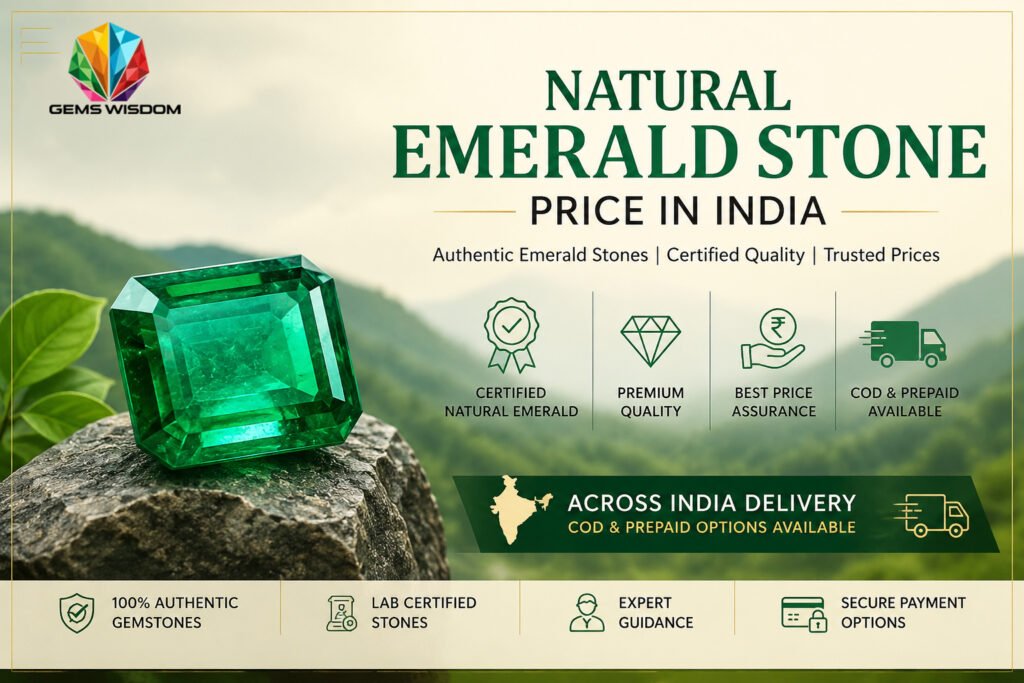
Emerald Stone Price in India currently falls between ₹3,000 and ₹2,00,000+ per carat — a wider range than most buyers expect, and one that has less to do with size than people assume. Two stones of identical carat weight can sit at opposite ends of that range simply based on where the stone came from and how much it’s been treated.
This is also the gemstone where buyers most often get misled. Because natural inclusions are nearly universal in emerald, sellers use “flawless” or “eye-clean” claims to justify inflated prices on stones that may not even be natural. Before looking at the price table below, it’s worth understanding what actually separates a genuinely Original Emerald Stone in India from a treated, synthetic, or misrepresented one — because getting that wrong costs far more than overpaying by a few thousand rupees.
What Makes a Stone “Original” — Not Just Natural
An Original Emerald Stone in India means three things are true at once: the stone is natural (not lab-grown), its treatment status is disclosed rather than hidden, and its origin claim is verifiable through certification. A stone can be natural and still be misrepresented — for instance, a heavily-treated Brazilian stone sold as “minor oiled Colombian” is technically a real emerald, but not an original one in the sense buyers mean when they use that word.
This distinction matters because “natural” and “original” get used interchangeably by sellers, but they’re not the same guarantee. A lab report should state both.
Natural Emerald Stone Price in India — By Origin
| Origin | Character | Price Range (per carat) |
|---|---|---|
| Brazil | Lighter tone, accessible entry point | ₹3,000 – ₹25,000 |
| Zambia | Cooler, bluer-green, strong clarity-to-price ratio | ₹25,000 – ₹90,000 |
| Colombia | Deepest saturation, market benchmark | ₹90,000 – ₹2,00,000+ |
These are indicative ranges. Two Colombian stones of the same carat weight can still differ several times over based on treatment level and clarity — always get a specific quote once you’ve narrowed down carat and origin.
What Actually Drives Cost Of Emerald Stone in India
Four factors decide where a stone lands in that range, and they don’t stack independently — they interact:
- Colour saturation — a vivid, even medium-to-deep green sits at the top; pale, overly dark, or yellowish stones are priced well below regardless of size.
- Origin — covered in the table above; this alone can create a 5–10x price difference.
- Treatment level — the single most misunderstood factor, covered in detail below.
- Carat weight and cut — emerald is almost always cut to preserve weight and hide inclusions, so a well-cut stone in a less common shape can cost more than a poorly-cut round of the same weight.
Certification is what ties all four together — a report that states origin, treatment category, and clarity grade is what actually justifies the Cost Of Emerald Stone in India you’re being quoted. A price without that documentation is just a number.
Treatment Disclosure: Why It Changes the Price So Much
Nearly all natural emeralds sold today — at any price point — are treated with oil or resin to fill surface-reaching fractures and improve apparent clarity. This is a long-standing, industry-accepted practice, not a red flag on its own. What matters is whether it’s disclosed and to what degree:
- Minor / insignificant treatment — least intervention, closest to natural state, priced highest
- Moderate treatment — the most common category in the mid-market
- Significant treatment — heavier oiling or resin filling to mask visible inclusions, priced lowest among natural stones
A trustworthy seller states which category a stone falls into, directly on the certificate. If a listing skips treatment status entirely, that’s a bigger warning sign than a stone that openly discloses moderate treatment — an undisclosed stone is one place where an “Original Emerald” claim quietly stops being true.
How to Confirm You’re Buying an Original Emerald Stone in India
Since authenticity is the biggest risk in this category, use this checklist before paying:
- Certificate names the lab and states treatment category explicitly — not just “natural” or “genuine,” which are incomplete claims for emerald specifically
- Don’t mistake inclusions for a defect — ask about clarity grade relative to typical emerald standards, not diamond standards; a suspiciously “flawless” stone at a low price is a bigger concern than one with visible internal characteristics
- Cross-check origin against price — a Colombian-grade quote at a Brazilian-grade price is worth questioning
- Ask how the stone should be cared for — a seller who can answer this in detail is generally more credible than one who can’t
Living With an Emerald: Care Notes
Emerald sits at 7.5–8 on the Mohs hardness scale — durable enough for daily wear, but oil/resin treatment means it needs different care than sapphire or diamond. Avoid ultrasonic cleaners and steam cleaning, both of which can dry out or damage the fill. Avoid prolonged exposure to hot water or harsh detergents. A soft cloth and mild soapy water is the safest routine cleaning method.
Gems Wisdom’s Approach to Emerald
Every Emerald listed by Gems Wisdom is lab-certified with the treatment category stated clearly, alongside origin and clarity grade — so the Natural Emerald Stone Price in India you see reflects a fully disclosed stone, not a guess dressed up as a bargain. Pan-India shipping is available with prepaid and cash-on-delivery options, and our team can help match carat weight, origin, and budget before you commit.
In Short
Emerald Stone Price in India isn’t a single number — it’s a function of origin, treatment disclosure, colour, and cut working together. The biggest buying mistake isn’t overpaying; it’s judging a stone purely on how “clean” it looks rather than asking what its certificate actually discloses. A well-documented, moderately treated Zambian stone is often better value — and more genuinely original — than an undisclosed “flawless” stone at the same price. Gems Wisdom’s certified Emerald collection makes that documentation the starting point of every listing, not an afterthought.
Buying for astrological use rather than jewellery? Emerald is known as Panna in Vedic astrology, worn for Mercury’s influence on intellect and career. See our Original Panna Stone Price in India guide for rashi suitability, wearing rituals, and gemstone combinations. To browse certified stones, visit our Emerald (Panna) Stone collection.
Roughly ₹3,000 to ₹2,00,000+ per carat, with origin and treatment level being the two biggest price drivers.
Emerald forms under geological conditions that almost always introduce internal fractures and mineral inclusions. This is expected and doesn't disqualify a stone as "natural" — a genuinely flawless emerald at a low price is more likely synthetic than exceptionally lucky.
No. Oiling or resin treatment is a disclosed, standard practice used on the vast majority of natural emeralds worldwide. A synthetic or fake stone is a completely different issue from a treated natural one.
Yes, substantially — Colombian material can cost several times more than Brazilian stones of similar visual quality, largely due to reputation and colour character rather than clarity alone.
Use a soft cloth with mild soapy water only. Avoid ultrasonic cleaners, steam cleaning, and prolonged heat or chemical exposure, since these can affect the oil/resin fill.
Origin and treatment level are the two biggest factors — certification that discloses both is what actually justifies the price you're quoted, more than carat weight alone