
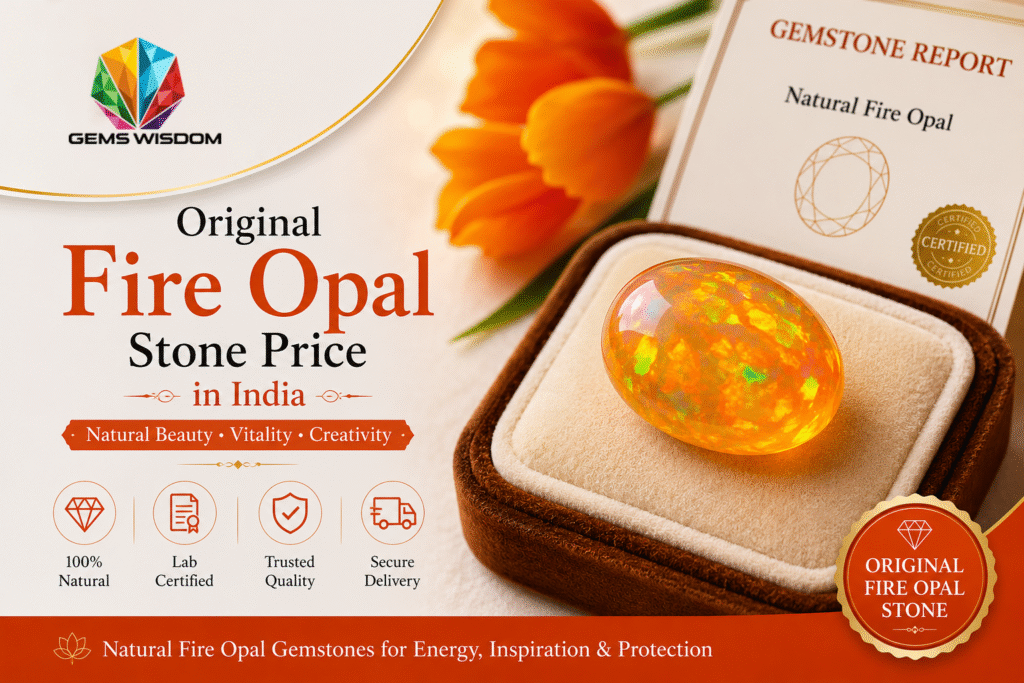
Fire Opal Stone Price in India typically ranges from ₹2,000 to ₹80,000+ per carat — a narrower, generally more affordable range than most other coloured gemstones. But arriving at the right cost of opal stone for a specific piece means understanding a few things that are unique to opal as a gem family, not just to Fire Opal.
(Comparing across the whole family? See our Opal Stone Price in India guide, which covers Fire, Black, and other varieties side by side.)
What Makes an Opal “Original” — and What Makes It “Fire”
Before price, buyers usually want to know how to tell an original opal stone from a treated or synthetic one — more on that in the certification section below. As for the “Fire” designation specifically: unlike most gemstones, opal’s value isn’t primarily about internal clarity or a single body colour — it’s about optical phenomena.
Fire Opal refers to a translucent-to-transparent orange, yellow, or red-bodied opal, prized for its warm, glowing “fire” colour rather than the flashing rainbow “play-of-colour” that defines Black Opal. Some Fire Opal does show play-of-colour on top of its body colour, and stones that do are priced meaningfully higher than those that don’t.
Where It Comes From
Mexico is the dominant and most historically significant source of Fire Opal, particularly from the states of Querétaro and Jalisco — so much so that “Mexican Fire Opal” functions almost as its own trade term. Ethiopian material has become more common in recent years and offers strong colour at generally lower prices, though it behaves differently in terms of stability (more on that below).
Fire Opal Stone Price in India — By Transparency Grade
| Grade | Description | Price Range (per carat) |
|---|---|---|
| Common / opaque | Solid body colour, no transparency | ₹2,000 – ₹10,000 |
| Jelly opal | Semi-transparent, gel-like appearance | ₹10,000 – ₹30,000 |
| Crystal opal | Highly transparent, vivid fire colour | ₹30,000 – ₹80,000+ |
| Crystal with play-of-colour | Transparent base plus flashes of colour | ₹80,000+ (rare, priced individually) |
Transparency grade is the single biggest driver of fire opal stone price in India — more than carat weight alone. Two stones of identical size can differ in cost by 5–10x depending on grade.
The Durability Question — Read This Before You Buy
This is the single most important thing about opal that doesn’t apply to any other gemstone: opal contains a meaningful percentage of water within its structure (roughly 3–21%), which makes it noticeably softer (5.5–6.5 on the Mohs scale, well below sapphire or ruby) and genuinely more fragile. Extreme dryness or sudden temperature changes can cause “crazing” — fine internal cracks that permanently dull a stone’s appearance.
This isn’t a defect in a specific stone; it’s a characteristic of the gem family. It means opal needs different handling than other gemstones: avoid prolonged direct sunlight, ultrasonic cleaners, and extreme temperature swings, and store it with a bit of humidity rather than in a bone-dry environment.
Treatment Disclosure
Some Fire Opal on the market is dyed to intensify or alter colour, or treated with resin to fill surface cracks — both should be disclosed on a proper certificate. Undisclosed dyeing is a more common issue for opal than for most other coloured gemstones, so this is worth asking about directly rather than assuming — it’s also the fastest way to confirm you’re getting an original opal stone and not an altered one.
Certification — What to Ask For Before You Pay
A certificate should state:
- Whether the stone is natural or treated (including dyeing and any fracture-filling)
- Origin, where determinable (Mexico vs. Ethiopia)
- Transparency grade
Because Fire Opal’s fragility makes returns and disputes more complicated after the fact, getting this documentation upfront matters more here than for a harder, more stable gemstone — and it’s the single biggest factor separating a fair cost of opal stone from an inflated one.
Fire Opal vs. Black Opal — Which Should You Choose?
If you’re drawn to a warm, glowing orange-red colour, Fire Opal is the natural choice and the more accessible entry point into opal collecting. If you’re drawn to flashing, rainbow-like play-of-colour against a dark background, that’s Black Opal’s signature — and typically a significantly higher investment. See our Black Opal Stone Price in India guide for that variety’s specific grading and origin (mainly Australia).
Why Buyers Choose Gems Wisdom for Fire Opal
Every Fire Opal listed through Gems Wisdom states transparency grade, treatment status, and origin clearly, with specific care instructions included given the gem’s sensitivity to dryness and temperature change. Pan-India delivery is available with prepaid and cash-on-delivery, and our team can advise on which grade suits your budget and how to care for the stone once it arrives.
Final Word
Original Opal Stone Price in India comes down to transparency grade first, treatment disclosure second, and — unusually for a gemstone — how well you’ll actually be able to care for it afterward. It’s one of the more approachable, affordable entry points into coloured gemstones, provided you understand it needs more care than sapphire, ruby, or emerald.
For a full comparison across all Opal varieties, including Opal Stone Price in India by type and grade, see our Opal Price in India guide. Certified, original Fire Opal is available in our Opal Stone collection.
The Fire Opal Stone Price in India currently ranges from roughly ₹2,000 to ₹80,000+ per carat. Transparency grade — common, jelly, or crystal — is the biggest price driver, followed by whether the stone shows play-of-colour.
Black Opal's rainbow play-of-colour against a dark body is rarer and more prized in the trade than Fire Opal's warm glow, and it's sourced almost exclusively from a few Australian deposits, making it inherently scarcer. This scarcity is why the Black Opal Stone Price in India typically runs well above Fire Opal at comparable sizes.
It can, if exposed to extreme dryness or sudden temperature changes, due to opal's water content. This isn't unique to lower-quality stones — it's a characteristic of the gem family and applies even to fine material if mishandled, regardless of where it falls in the Opal Stone Price in India range.
It can still be considered genuine, provided the treatment is disclosed — dyed or resin-treated stones are a legitimate, lower-priced category within the opal market. The concern with calling something an original opal stone in India only arises when treatment isn't disclosed and a stone is sold as fully natural at natural-stone prices.
The cost of Opal stone in India varies significantly by variety: Fire Opal is generally more affordable than Black Opal but can cost more than common white or milk opal, depending on transparency grade and whether play-of-colour is present.
Store away from direct heat and extreme dryness, avoid ultrasonic cleaners, and clean gently with a soft, slightly damp cloth rather than soaking or steaming. Following this care routine helps protect the value of any Fire Opal Stone Price in India purchase over time.