
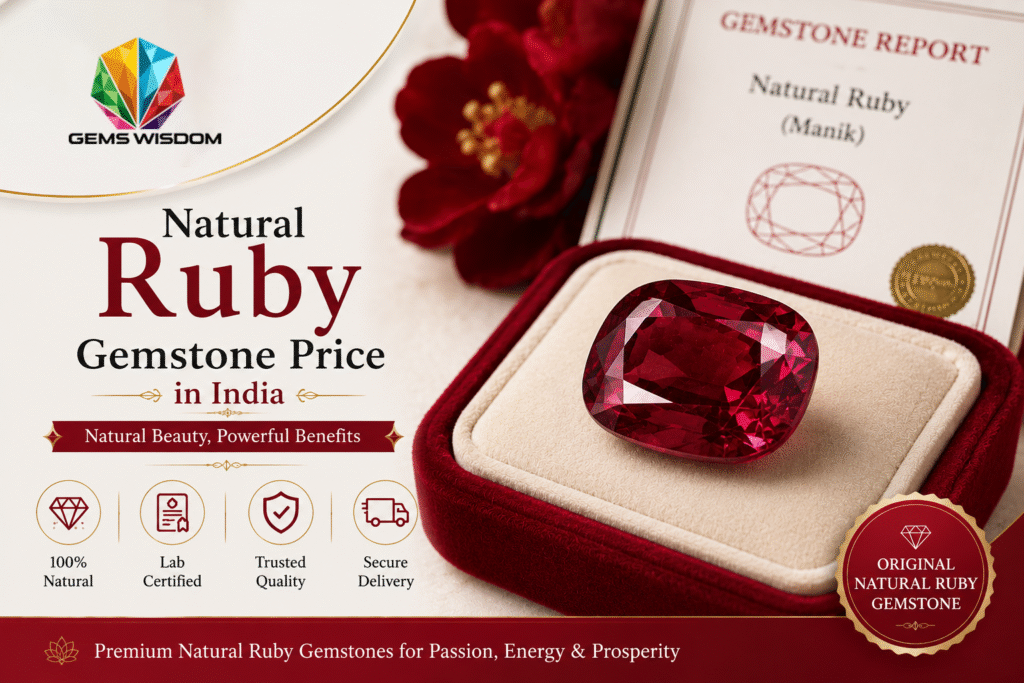
| Ruby Gemstone Price Range | ₹5,000 – ₹3,00,000+ per carat |
| Biggest Price Driver | Origin + heat treatment status |
| Best Value Origin | Mozambique |
| Rarest, Highest-Value Origin | Burma (unheated) |
Natural Ruby Gemstone Price in India spans a genuinely enormous range — a certified, heat-treated commercial stone and an unheated Burmese ruby of the same carat weight can differ by 20x or more. That gap isn’t marketing exaggeration; it reflects real differences in rarity, and understanding why matters more than memorising a single “average” Ruby Stone Price in India figure.
Origin Snapshot
Burma (Myanmar) remains the historical benchmark for ruby, particularly stones from the Mogok region, prized for a red that stays vivid under both daylight and artificial light. Mozambique has become the dominant modern source, producing strong colour at meaningfully lower prices, making it the practical choice for most certified buyers today. Thailand and Sri Lanka round out the market with more affordable, typically more heavily treated material — a major reason the Cost Of Ruby Gemstone in India can vary so widely between two visually similar stones.
The Grading Question: “Pigeon Blood” and Beyond
Trade terminology around ruby colour can be confusing, so here’s the plain version: the top grade is a vivid red with a slight purplish undertone, historically called “pigeon blood,” associated most strongly with fine Burmese stones. Below that, colour moves through purplish-red, red, orangey-red, and pinkish-red — each step down in saturation typically means a step down in Cost Of Ruby Gemstone in India. A stone doesn’t need top-grade colour to be a good, legitimate purchase; it just needs its grade to be accurately reflected in the price you pay.
Heat Treatment, Glass-Filling, and What They Actually Mean for Price
Most rubies sold today, across every origin, are heat-treated — a long-accepted practice that improves colour and reduces silk-like inclusions. This is disclosed, standard, and shouldn’t be treated as a red flag on its own. What buyers genuinely need to watch for is a different, lower category: lead-glass filling, used to fill larger fractures in lower-grade rough. Glass-filled stones look dramatically better than the rough they started as, but they’re structurally fragile, hold almost no resale value, and should be priced — and disclosed — as an entirely separate category from a simple heat-treated Natural Ruby. If a certificate doesn’t clearly distinguish between these two, ask directly before paying.
Carat, Cut, and the Size Premium
Ruby follows the same nonlinear pricing curve as most coloured gemstones: a 2-carat stone of a given quality typically costs more than double a 1-carat stone of the same quality, since larger clean rough is disproportionately rare. This nonlinear jump is one of the main reasons the Ruby Gemstone Price in India can look inconsistent at first glance — two stones a carat apart aren’t priced a carat apart. Cut affects this too — a shallow or poorly proportioned cut can make a stone appear larger for its weight while sacrificing brilliance, a trade-off worth understanding before comparing prices purely by carat.
Certification Checklist
A certificate you can rely on states: carat weight and measurements, an origin opinion where determinable, and — critically for ruby — explicit treatment disclosure that names whether the stone is heat-treated only, or glass-filled. Reports that use vague language like “enhanced” without specifying the treatment method are worth questioning directly, since this single line is often what separates a fair Cost Of Ruby Gemstone in India from an inflated one.
Jewellery Considerations
Ruby’s hardness (9 on the Mohs scale, tied with sapphire) makes it genuinely well-suited to daily-wear rings, unlike glass-filled stones, which are more fragile and better suited to occasional-wear pendants or earrings. White metals (platinum, white gold) tend to make the red appear cooler and more saturated; yellow gold gives a warmer, more traditional look that pairs well with deeper red tones.
Common Buying Mistakes
The most frequent mistake isn’t buying a fake stone — it’s buying a real but heavily glass-filled stone at a price that assumes simple heat treatment. The second most common mistake is judging quality purely from a product photo; ruby colour shifts noticeably under different lighting, and a certificate matters more than any image. The third is treating “certified” as a guarantee on its own — always check what specifically the certificate states about treatment, not just that one exists.
Gems Wisdom’s Ruby Standard
Every Ruby Gemstone listed through Gems Wisdom carries a certificate that names origin (where determinable) and states treatment type explicitly, including the heat-treatment versus glass-filling distinction that matters most for pricing accuracy. Pan-India delivery is available with prepaid and cash-on-delivery, and our team can help you weigh origin, grade, and budget against each other before you commit — so the Natural Ruby Gemstone Price in India you pay always matches what’s actually on the certificate.
The Real Takeaway
Ruby Gemstone Price in India isn’t really about finding the “right” number — it’s about matching price to two disclosures: origin and treatment type, confirmed on a proper certificate rather than a product photo or a seller’s claim alone. A well-documented, heat-treated Mozambique stone is often better value than an undocumented “natural Burmese” stone at a similar price. Gems Wisdom builds every Ruby listing around that same certification standard, so you’re paying a fair Cost Of Ruby Gemstone in India for what’s actually on the certificate, not just what’s in the photo.
Buying Ruby specifically for its astrological effect? Our Manik Stone Price in India guide covers Sun-sign suitability, wearing rituals, and gemstone pairings in detail. Certified Ruby stones are available in our Manik (Ruby) collection.
Ruby Gemstone Price in India ranges from ₹5,000 to ₹3,00,000+ per carat, driven mainly by origin, treatment status, and colour grade.
Natural Ruby Gemstone Price in India depends on origin, clarity, and treatment, with unheated Burmese stones commanding the highest per-carat value.
Cost Of Ruby Gemstone in India is driven mainly by origin and treatment; certified Mozambique stones offer strong value at lower prices.
Origin and treatment explain most gaps. Unheated Burmese rubies sit at the top; heat-treated Mozambique stones form the accessible middle tier.
Heat treatment is standard and disclosed, so it doesn't disqualify a stone, but it places it below a comparable untreated ruby
Yes, glass-filled rubies cost significantly less since they're structurally weaker and hold little resale value compared to simple heat-treated stones.