
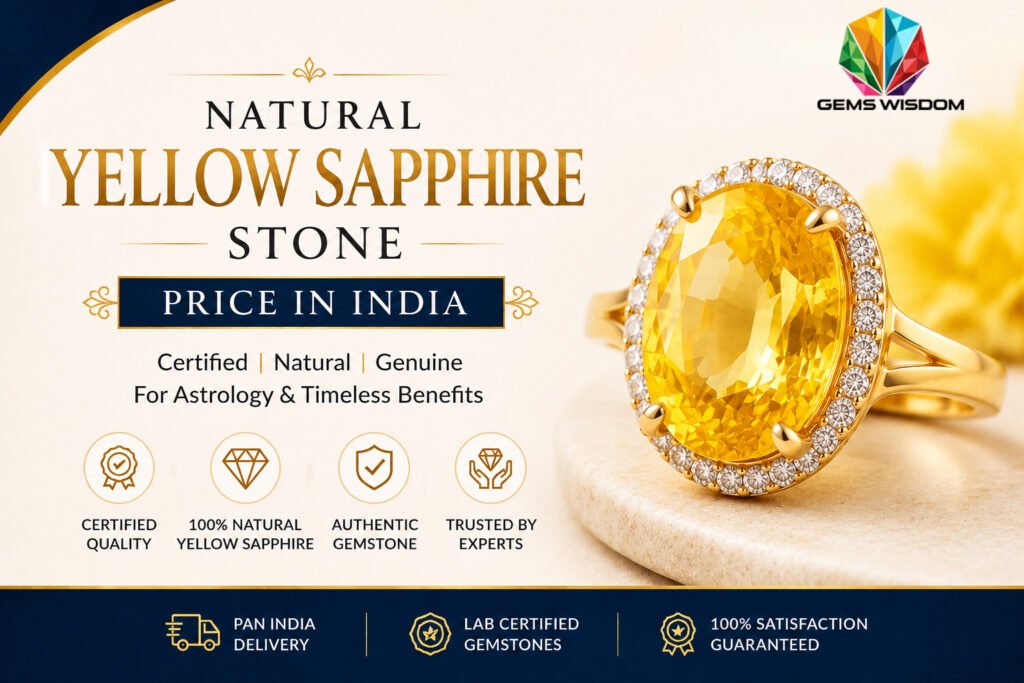
Yellow Sapphire Stone Price in India runs from around ₹4,000 to ₹2,50,000+ per carat. Rather than starting with the usual list of price factors, it’s more useful to start with how gemologists actually read a yellow sapphire’s colour — since that single skill explains most of the price variation you’ll encounter while shopping.
Reading the Colour Spectrum
| Colour Description | Market Position | Typical Price (per carat) |
|---|---|---|
| Pale, greenish-yellow | Entry level | ₹4,000 – ₹20,000 |
| Golden yellow, moderate saturation | Mid-market | ₹20,000 – ₹90,000 |
| Vivid canary yellow, high saturation | Premium | ₹90,000 – ₹2,50,000+ |
Canary yellow — a pure, intense, slightly warm yellow with no green or brown undertone — is the benchmark top grade, most consistently found in fine Ceylon material. Most commercial stones fall into the golden-yellow middle tier, which offers the best balance of beauty and Yellow Sapphire Stone Cost in India for everyday buyers.
Where It Comes From
Ceylon (Sri Lanka) remains the most consistent source for high-saturation, well-formed yellow sapphire and commands the strongest prices accordingly. Thailand supplies a large share of the treated, mid-market stones seen in most jewellery. Madagascar has emerged as a source of well-priced material with good clarity, sitting comfortably in the mid-range.
The Corundum Question
One thing worth knowing before you shop: yellow sapphire (corundum) is sometimes confused with — or substituted for — citrine and certain treated topaz stones, which look similar but are entirely different, far less valuable minerals. This matters enough that we’ve covered it in full detail on our Original Pukhraj Stone Price in India guide, including exactly what to ask a certifying lab. The short version for jewellery buyers here: make sure any certificate you’re given identifies the mineral species as corundum, not just the colour and clarity.
Treatment: What’s Standard and What to Ask
Heat treatment is extremely common for yellow sapphire and is an accepted, disclosed industry practice that improves colour saturation and clarity. It’s not a red flag on its own. What you should confirm is simply whether a stone is treated or untreated, since untreated stones — genuinely rarer — command a meaningful premium and are typically what astrology-focused buyers are looking for specifically.
Certification Essentials
A certificate worth relying on states: mineral identification (corundum), origin where determinable, treatment status, carat weight, and clarity grade. Missing any one of these — especially mineral identification — is a gap worth questioning before you pay Yellow Sapphire Gemstone Price in India at the higher end of the range.
Jewellery Use Notes
Yellow sapphire’s hardness (9 on the Mohs scale) makes it a durable, practical choice for daily-wear rings, similar to its blue counterpart. It pairs particularly well with yellow or rose gold, which complement its warm tone, though white metals are increasingly popular for a more contemporary look. Ring settings that allow light to pass through the pavilion (open-back settings) tend to show off colour saturation best.
Red Flags to Watch For
Prices significantly below the ranges above, for a stone described as “natural” and “bright yellow,” are the clearest warning sign of undisclosed treatment or an outright substitute mineral. A seller unwilling to confirm mineral species on request is a second warning sign worth taking seriously, particularly given how often this specific gemstone is misrepresented in the wider market.
Gems Wisdom’s Approach
Every Yellow Sapphire Gemstone listed through Gems Wisdom is verified as genuine corundum before certification for treatment and origin — addressing the substitution risk at the sourcing stage, not just at the paperwork stage. Pan-India delivery is available with prepaid and cash-on-delivery, with our team available to help match colour grade and origin to your budget.
One Page Summary
Yellow Sapphire Stone Price in India comes down to three checks, in order of importance: is it genuinely corundum, is treatment disclosed, and how does the colour and origin compare to the ranges above. Get those three right and the price you’re paying will actually reflect what’s in your hand, not just what’s in the photo. Gems Wisdom verifies all three before any stone reaches our catalogue.
Buying specifically for Jupiter’s astrological effect? Our Original Pukhraj Stone Price in India guide covers suitability, wearing rituals, and the citrine-substitution issue in full detail. Certified stones are available in our Yellow Sapphire (Pukhraj) collection.
Roughly ₹4,000 to ₹2,50,000+ per carat, with vivid canary-yellow Ceylon stones at the top and treated mid-market stones from Thailand forming the accessible middle.
No real difference — both refer to the same stone and the same price range. "Stone" and "gemstone" are used interchangeably by Indian buyers and sellers.
Treatment status and origin are the biggest factors — an untreated Ceylon stone can cost 3-5x more than a heat-treated stone of comparable colour and brightness, even at the same carat weight.
Yes — heat treatment is a standard, widely disclosed practice that improves colour, and it's an entirely different issue from a stone that isn't corundum at all.
Colour alone can't reliably distinguish them. A lab certificate that explicitly identifies the mineral as corundum is the only reliable confirmation — this is covered in more depth on our Pukhraj guide.
Yes — larger clean stones are disproportionately rare, so price increases faster than carat weight alone would suggest, especially above 3 carats.