
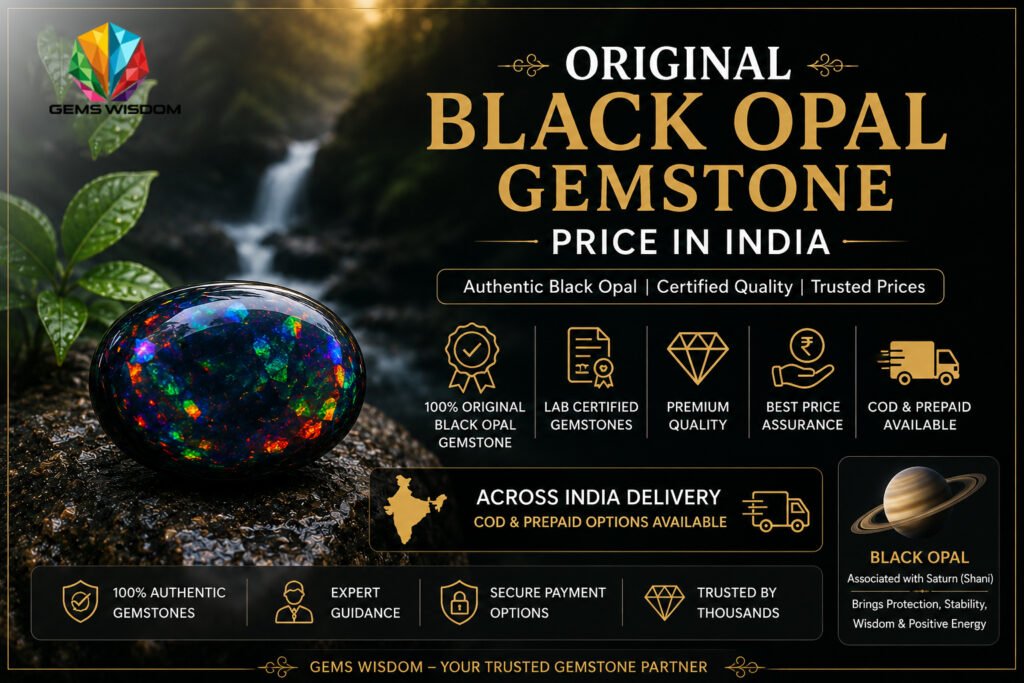
Black Opal Gemstone Price in India starts around ₹15,000 per carat and can exceed ₹5,00,000+ per carat for exceptional stones — the widest price spread of any gemstone covered on this site, and one that makes sense once you understand how black opal is actually graded.
(Comparing across the whole family, including the more affordable Fire Opal Gemstone in India? See our Opal Stone Price in India guide.)
Understanding Play-of-Colour Grading
Unlike almost every other gemstone, black opal isn’t primarily valued for clarity or a single body colour — it’s valued for play-of-colour: the flashes of spectral colour that shift and shimmer as the stone moves under light. Gemologists assess this on a few dimensions at once:
- Brightness — how vivid the flashes are
- Pattern — trade terms like “harlequin,” “floral,” and “rolling flash” describe how the colour is arranged, with harlequin patterns commanding the highest premiums
- Colour range — stones flashing red (the rarest spectral colour to see in opal) are valued well above those showing mainly blue and green
This grading system is the single biggest reason the Black Opal Gemstone Price in India varies so widely between stones that look similar at a glance.
Body Tone: The N1–N9 Scale
Underneath the play-of-colour sits the body tone — how dark the stone’s background is — graded on a standard N1 (jet black) to N9 (white) scale. Genuine black opal generally falls in the N1–N4 range. A darker body tone makes flashes of colour appear more vivid by contrast, which is the entire reason black opal commands such a premium over lighter opal varieties, including Fire Opal Gemstone in India, that show similar play-of-colour.
Where Black Opal Actually Comes From
This is worth knowing before you shop: the overwhelming majority of the world’s black opal comes from one place — Lightning Ridge, in New South Wales, Australia. Unlike Fire Opal, Ruby, or Sapphire, where multiple countries supply meaningful volume, black opal doesn’t really have a “budget origin” alternative. This single-source scarcity is a major reason genuine black opal never gets particularly cheap, even at entry-level grades — and part of why the Black Opal Gemstone Price in India consistently runs above other opal varieties.
Black Opal Gemstone Price in India — By Grade
| Grade | Play-of-Colour | Price Range (per carat) |
|---|---|---|
| Entry, N4 body tone | Moderate brightness, blue-green flash | ₹15,000 – ₹60,000 |
| Mid-grade, N2–N3 | Bright, multi-colour flash | ₹60,000 – ₹2,00,000 |
| Fine, N1–N2 | Vivid, red-inclusive flash, harlequin pattern | ₹2,00,000 – ₹5,00,000+ |
Exceptional individual stones — large, vivid, red-flashing, harlequin-pattern black opal — are effectively priced case by case and can exceed this range significantly.
The Doublet and Triplet Issue
This matters specifically for black opal: because fine solid black opal is rare and expensive, a large share of the market consists of doublets (a thin slice of natural opal glued onto a dark backing to simulate body tone) and triplets (the same, with a protective quartz or glass cap on top). These aren’t fakes — they’re a legitimate, disclosed, lower-cost category — but they should never be priced or sold as solid natural black opal.
A proper certificate must state whether a stone is solid, a doublet, or a triplet, since the price difference between categories is enormous for otherwise similar-looking stones — and this classification is often the single biggest lever on the final Black Opal Gemstone Price in India you’re quoted.
Care Note
Black opal shares the same fragility as other opal varieties — it contains water within its structure and can crack under extreme dryness or temperature swings. Since this applies to the whole opal family rather than being unique to black opal, our Fire Opal Gemstone in India guide covers detailed care and storage instructions that apply here too.
Certification Essentials
Look for a certificate stating:
- Solid, doublet, or triplet classification
- Origin, where determinable
- Body tone grade
- A description of play-of-colour pattern and brightness
A listing that only says “natural black opal” without addressing the solid/doublet/triplet question is missing the single most important piece of information for this gemstone specifically.
How to Choose the Best Black Opal
Prioritise pattern and brightness over sheer size — a smaller stone with vivid, well-distributed colour flash typically outperforms a larger, duller one in both beauty and long-term value. Confirm solid/doublet/triplet status before comparing prices between sellers, since comparing a solid stone’s price to a triplet’s price is comparing two different products. Buy only from sellers who can explain grading terminology specifically, not just “premium quality” marketing language.
Why Buyers Choose Gems Wisdom for Black Opal
Every Black Opal gemstone through Gems Wisdom is certified with solid/doublet/triplet classification stated explicitly, alongside body tone and play-of-colour description — the exact information this category needs most. Pan-India delivery is available with prepaid and cash-on-delivery, and our team can help you understand grading terminology before you commit to a purchase at this price range.
In Summary
Black Opal Gemstone Price in India is really a function of three things: body tone, play-of-colour quality, and whether the stone is solid, a doublet, or a triplet — get those three confirmed on a proper certificate, and you’ll understand exactly why two similar-looking stones can be priced worlds apart. Gems Wisdom states all three clearly on every listing, since guesswork has no place at this price range.
Want to compare across Opal varieties, including the more affordable Fire Opal Gemstone in India? See our Opal Price in India guide. Certified Black Opal is available in our Opal Stone collection.
The Black Opal Gemstone Price in India ranges from around ₹15,000 per carat for entry-grade stones to ₹5,00,000+ per carat for fine, harlequin-pattern material. Body tone (N1–N4), play-of-colour quality, and solid/doublet/triplet classification together determine where a stone falls in that range.
Black opal is sourced almost exclusively from Lightning Ridge, Australia, giving it far less supply than the more accessible Fire Opal Gemstone in India, which is sourced from multiple countries including Mexico and Ethiopia. Black opal’s darker body tone also makes its play-of-colour appear more vivid, which the trade prices at a premium.
A proper certificate will state this classification explicitly. Solid stones are natural opal throughout; doublets have a thin opal slice glued to a dark backing; triplets add a protective cap on top. This single detail affects the Black Opal Gemstone Price in India more than almost any other factor, so always confirm it before comparing prices between sellers.
Yes — black opal shares the same water content and fragility as other opal varieties, including Fire Opal, and can crack under extreme dryness or sudden temperature changes. The same care guidelines (avoid direct heat, ultrasonic cleaners, and prolonged dryness) apply across the opal family.
It’s the body tone scale used to grade how dark an opal’s background is, from N1 (jet black) to N9 (white). Genuine black opal typically falls between N1 and N4 — the darker end of the scale — which is part of why the Black Opal Gemstone Price in India rises sharply as body tone gets darker.
Yes. Red is the rarest spectral colour to see as play-of-colour in opal, so stones showing red flashes are valued well above those showing mainly blue and green, especially when combined with a harlequin pattern and dark body tone.