
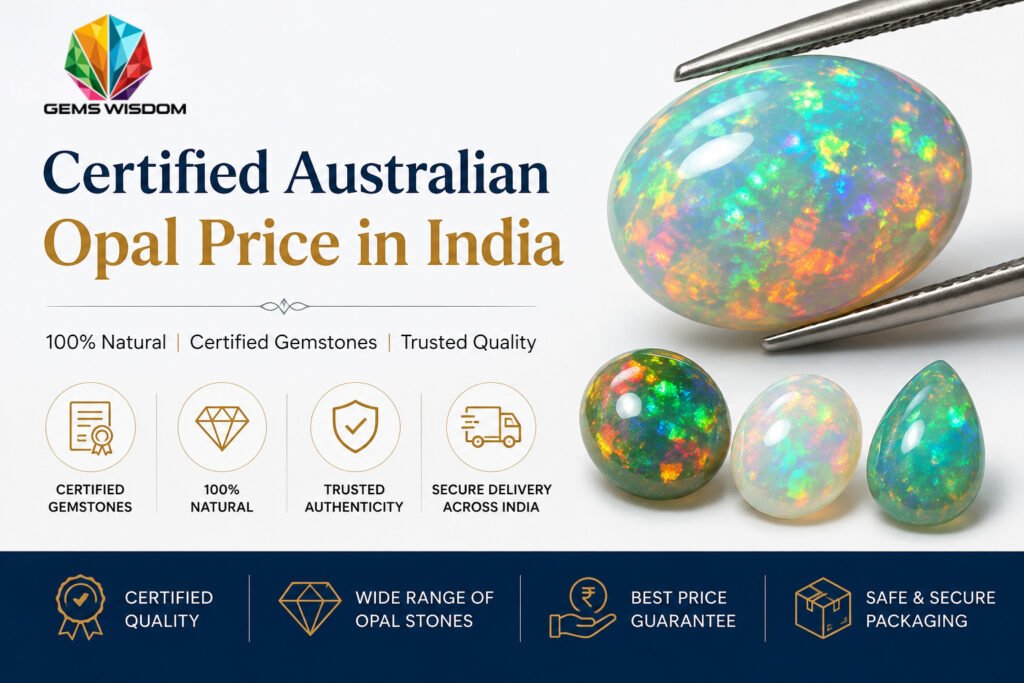
Opal Price in India covers an unusually wide range — roughly ₹1,500 to ₹5,00,000+ per carat — because “opal” isn’t really one gemstone. It’s a family of several visually distinct varieties, each with its own rarity, origin, and pricing logic. Understanding which type you’re actually looking at is the real starting point for Cost Of Opal Stone, more useful than any single price figure.
The Five Main Types of Opal
| Type | Appearance | Typical Price (per carat) |
|---|---|---|
| White / Milk Opal | Pale, milky body, subtle colour play | ₹1,500 – ₹15,000 |
| Crystal Opal | Transparent to semi-transparent, vivid flash | ₹10,000 – ₹1,00,000+ |
| Boulder Opal | Thin colour layer on natural ironstone backing | ₹8,000 – ₹1,50,000+ |
| Fire Opal | Translucent orange/red/yellow body, warm glow | ₹2,000 – ₹80,000+ |
| Black Opal | Dark body tone, vivid rainbow play-of-colour | ₹15,000 – ₹5,00,000+ |
Fire Opal and Black Opal are the two most commonly searched varieties in India, and each has genuinely different pricing logic — enough that we’ve covered them separately in full depth: see our Fire Opal Stone Price in India and Black Opal Gemstone Price in India guides.
Why the Price Range Is So Wide
Two mechanisms drive value across all opal varieties, and they don’t always move together. Play-of-colour — the flashing, shifting spectral colour seen in crystal, boulder, and black opal — is judged on brightness, pattern, and colour range, with red flash being the rarest and most valuable to see. Body colour, by contrast, is what drives Fire Opal’s value, which typically shows little or no play-of-colour and is priced instead on the depth and clarity of its orange-red glow. A stone can be expensive through either mechanism, which is why comparing “opal to opal” by price alone, without knowing the type, rarely makes sense.
Where Opal Comes From
Australia dominates global opal production and is essentially the sole meaningful source of genuine black opal, along with the majority of crystal and boulder opal. Mexico is the historic source for Fire Opal, with Ethiopia increasingly supplying strong colour at more accessible prices in recent years. Origin affects both price and, in some cases, durability — Ethiopian opal in particular is known to be more prone to crazing (fine internal cracking) than Australian material, which is worth knowing if you’re comparing stones purely by price.
A Word on Durability, Before You Buy Anything
Every opal variety shares one trait that sets the whole family apart from harder gemstones like sapphire or ruby: it contains water within its structure, making it softer and more sensitive to extreme dryness, heat, and sudden temperature change. This affects how you should store, wear, and clean any opal you buy, regardless of type. Our Fire Opal guide covers specific care instructions in detail — worth reading before your first opal purchase, whichever variety you end up choosing.
Certification: What It Should Cover
Whatever type of opal you’re buying, a proper certificate should state the variety (white, crystal, boulder, fire, or black), origin where determinable, and treatment status — including whether a stone is solid, or a doublet/triplet assembled from a thinner natural layer. This last point matters most for black and boulder opal specifically, where assembled stones are common and legitimate, but should never be priced as solid natural material.
Buying Tips
Identify the type first, then compare prices only within that type — a Fire Opal and a Black Opal at the same per-carat price are not comparable purchases. Ask directly whether a stone is solid or assembled (doublet/triplet), particularly for darker or boulder varieties. Buy from sellers who can explain grading terminology specifically — brightness, pattern, body tone — rather than relying on vague “premium quality” language alone.
Gems Wisdom’s Opal Collection
Gems Wisdom offers certified opal across multiple varieties, with type, origin, and treatment status stated clearly on every listing, along with care guidance specific to opal’s sensitivity. Pan-India delivery is available with prepaid and cash-on-delivery, and our team can help you choose the right variety and grade for your budget.
The Bottom Line : Opal Price in India
Opal Price in India only makes sense once you know which of the five main types you’re actually comparing — get that right, then evaluate play-of-colour or body colour, origin, and solid-vs-assembled status specifically for that type. Gems Wisdom’s collection spans the range, with the documentation to match each stone’s actual category rather than a single generic “opal” listing.
Explore our in-depth guides: Fire Opal Stone Price in India and Black Opal Gemstone Price in India. Browse certified stones in our Opal Stone collection.
Roughly ₹1,500 to ₹5,00,000+ per carat, with the huge range driven by which opal variety you're looking at — Black Opal sits at the top, White Opal at the entry level.
No real difference — both refer to the same pricing question. The bigger factor is always which opal type you're pricing (White, Crystal, Boulder, Fire, or Black), since each has its own range.
Black Opal, generally — fine Australian black opal with strong red play-of-colour can reach ₹5,00,000+ per carat, making it the most valuable of the five main opal types.
Not always solid. Black and Boulder Opal are often sold as doublets or triplets — a thin natural layer bonded to a backing — which is legitimate if disclosed, but should never be priced as solid natural opal.
Opal contains water within its structure, making it softer and more sensitive to heat, dryness, and sudden temperature changes than harder stones like sapphire or ruby — it needs different care and storage.
It depends on what you're valuing — Fire Opal is priced on body colour and glow, while Black Opal is priced on play-of-colour and rarity. See our Fire Opal and Black Opal guides for the full comparison.